Do ask for more than is offered to them;
Do try to talk with people who are better known or of higher status than they are;
Do admit their failings and mistakes;
Do celebrate success publicly;
Do change their mind once it has been made up;
Do try things that could fail badly;
Do give up, no matter whether circumstances and goals change;
Do question what everybody else does;
Do ask others for help.
I know of a little boy who was constantly put in a cardboard box that the teacher took the time to paint black on the inside. She even put a chair and a desk so he’d be comfortable. He wasn’t comfortable; he was traumatized. He also had learning and emotional disabilities. He was five years old.
“The isolation box is not a far cry from solitary confinement that is used in jails as a punishment for dangerous prisoners. Although the children are placed inside the box for a limited time, the psychological effect is far more likely to be damaging than “therapeutic,” as the school claims.”
Isolation room. The box. The naughty room. Isolation booth. Therapeutic chamber. The scream room. Mop closet. Seclusion room.
Call it what you will, but what it does is it serves to instill fear in children. The one shown in the video is at an elementary school. And I couldn’t agree more with the mother unless you have the skills and understanding AND research to back it up:
“If you feel like you have to lock a child up, they shouldn’t be in public school,” Ana Bate told KATU. “I don’t think it gets any clearer than that.”
While teaching at a center known specifically to cater to students with learning and emotional disabilities, we didn’t have one. We had policies and procedures in place should a student get violent. We had a team of social workers, psychologists, trained teachers, and caring individuals to provide the necessary interventions. We had a security team if the situation became dangerous. But we did not have solitary – ahem – ‘therapeutic chambers’. And this was at the secondary level where most of my students were larger than me.
According to national Department of Education data, most of the nearly 40,000 students who were restrained or isolated in seclusion rooms during the 2009-10 school year had learning, behavioral, physical or developmental needs, even though students with those issues represented just 12 percent of the student population. African-American and Hispanic students were also disproportionately isolated or restrained.
While no longer surprising, this is painful. And disgusting.
Joseph Ryan, an expert on the use of restraints who teaches at Clemson University, told me that the practice of isolating and restraining problematic children originated in schools for children with special needs. It migrated to public schools in the 1970s as federal laws mainstreamed special education students, but without the necessary oversight or staff training. “It’s a quick way to respond but it’s not effective in changing behaviors,” he said.
State laws on disciplining students vary widely, and there are no federal laws restricting these practices, although earlier this year Education Secretary Arne Duncan wrote, in a federal guide for schools, that there was “no evidence that using restraint or seclusion is effective.” He recommended evidence-based behavioral interventions and de-escalation techniques instead.
The use of restraints and seclusion has become far more routine than it should be. “They’re the last resort too often being used as the first resort,” said Jessica Butler, a lawyer in Washington who has written about seclusion in public schools.
So the research does not back it up. Then why are schools still using it? I don’t know.
What I do know is that if we do not have the skills and the training and the research to back up our practices in the schools and in the classrooms then we better get that training or get out. Being a teacher is not for you.
“Curriculum content and resources is the area in which we have made the most progress as compared to other areas of education and curriculum. In this video, Dr.Nadeem presents 4 considerations to keep in mind when integrating at the content level, as well as 5 content types you can use in your classroom. Step 3 is all about creating a holistic curriculum matched with resources for your defined learning outcomes.”
“As for accountability of teachers and administrators, Sahlberg shrugs. ‘There’s no word for accountability in Finnish,’ he later told an audience at the Teachers College of Columbia University. ‘Accountability is something that is left when responsibility has been subtracted.’ ”
There are many things that were non-issues when I was in school. I do remember specific books being banned or censored which always made me think of Fahrenheit 451 (not to be confused with the Michael Moore documentary). And there were guidelines regarding clothing, but I don’t recall anything too strenuous.
Rules and guidelines are meant to promote student learning. They are also meant to ensure the safety of students. But what if they do neither? This article in the Huffington Post provides a good slide show of what’s been banned in schools throughout the US, UK and Canada. The list is at times understandable, confusing, and in some instances lacking any significant research.
From serious issues – no rosaries which sets a dangerous precedent for all things referring to freedom of religious expression – to the more bizarre – no bffs – really?!?! – to no winning – right, we’d all like to be losers.
No wonder some children would rather do anything but school. And those that do, are we even surprised why they are so disengaged? While some of these seem very reasonable and the intention may even be in the right place, research may indicate that such action actually does nothing but cause frustration. A topic worth exploring further in the near future.
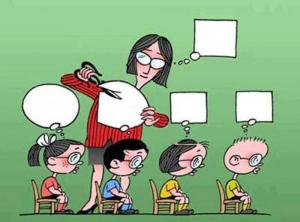
This image made me sad. This is what we are required to do with our students in this standardized-testing world. There is very little room for anything more. The image is referred to as education editting. Others have said to think outside the box.
My take: get rid of the box. Keep the circles, the rectangles, the triangles and squares. The cones, the spheres, the cylinders and trapezoids. I know, it should rhyme, but I’m no Dr Seuss. Instead of trying to fix a system that is not working, perhaps we need to come up with a new way of thinking and doing and being.

 Do change their mind once it has been made up;

 black board, white chalk