What’s not on the Test

•January 31, 2013 • Leave a Comment

Image source can be found here.

Archaeological Expedition

•January 30, 2013 • Leave a Comment

“I do not help students become better thinkers when I make it easier for them to glean anything. Education is the process of gleaning. Everything else is information. “What they need to know” is precisely what they should be there to discover. Education is not supposed to be a “greatest hits” album of what people need to know. It should be a process of exploration and discovery…an adventure of trial-and-error…an archaeological expedition, unearthing thought that came before and deciding what to toss, what to keep, and how to use it.

“If our elementary and our secondary educational system didn’t function this way, our college students would not expect this four-year “packet of information.” If our children grew up viewing learning as play, viewing education as an adventure, with the freedom to decide what to read and what to think about – and what not to think about – then I firmly believe that the students in my classroom would be engaged. They would be interested. They would read what I assign, or they would say, “I don’t want to read that. I would much rather read *this* instead, which is also relevant to the course.”

“How I would love it if a student said that to me. In the meantime, I’m still working on finding that magic solution.”

Read this full awesome post by An Unschooling Professor, here.

Home Educator

•January 30, 2013 • Leave a Comment

100_2887blog

“Every involved parent is a home educator. If you’re checking your child’s compositions, talking him through his history homework, or drilling him in math, you’re already teaching him. In this case, you’re acting as a teacher’s aide – helping to teach and reinforce material that has already been presented in the classroom.”

~ Jessie Wise & Susan Wise Bauer,  The Well-Trained  Mind.

Kindergarten Spaces and Places

•January 29, 2013 • 2 Comments

According to Timbuktu, these are the 10 most beautiful kindergartens in the entire world. What is interesting about this piece are the locations and who built the buildings. While I would be more inclined to see how the inside looks as well as the outside, and also what philosophy of education is at each school, there are two that stood out for me. The reasons being was seeing these schools through the Jibbers’ eyes and knowing what he would gravitate towards.

1) Kindergarten Kekec, Ljubljana, Slovenia

The vertical panels on the exterior of the school can be easily turned around, allowing kids to play with their own school building. Being able to change your school building is pretty neat. But more than that it gives a sense of ownership to the students. That’s important in developing a sense of ownership in terms of their education, and the goals of life-long learning.

2) Ring Around a Tree, Fuji

How can this not be fun, engaging and interesting: a kindergarten that is a playground and tree house too! While I have no intention of sending the Jibbers to kindergarten in Fuji, the idea of being outdoors for most of the day, connected and close to nature is awesome. Just imagine the creativity and play this would spur? I’m sure it doesn’t take much to connect with students in such a great play space/learning center underneath the big blue sky.

What would your child’s perfect kindergarten look like?

A reason to dance.

•January 29, 2013 • Leave a Comment

I have seen this video all over the internet and couldn’t help, but share.

Isolation & Restriction

•January 28, 2013 • Leave a Comment

“We have completely isolated young people from adults and created a peer culture. We stick them in school and keep them from working in any meaningful way, and if they do something wrong we put them in a pen with other “children.” In most nonindustrialized societies, young people are integrated into adult society as soon as they are capable, and there is no sign of teen turmoil. Many cultures do not even have a term for adolescence. But we not only created this stage of life: We declared it inevitable.”

Read more of this interesting and thought provoking interview with  Robert Epstein, psychologist.

Agism

•January 28, 2013 • Leave a Comment
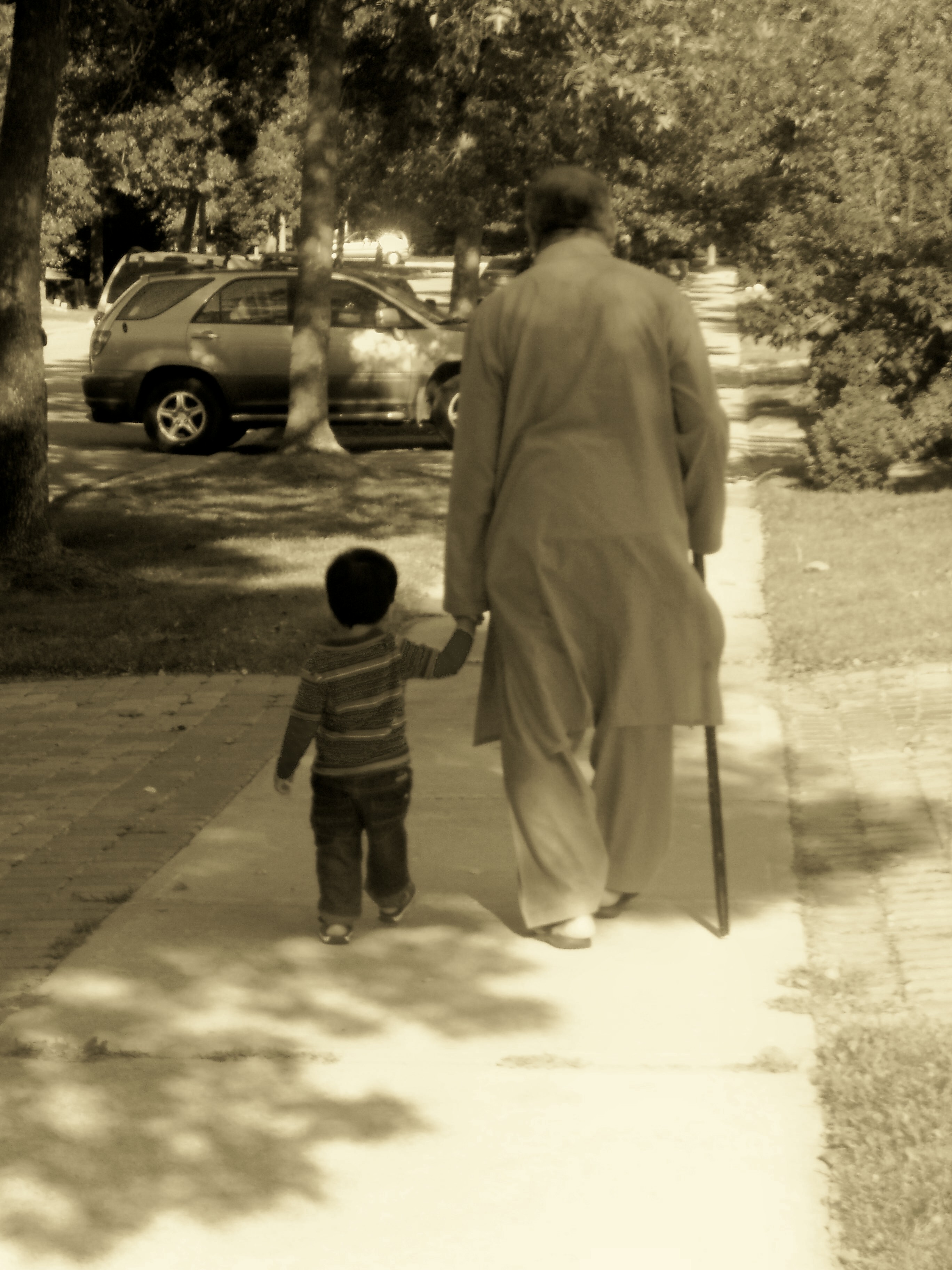
The Jibbers and his Napa, 2010

The Jibbers and his Napa, 2010

Segregating the old and the sick enables a fantasy, as baseless as the fantasy of capitalism’s endless expansion, of youth and health as eternal, in which old age can seem to be an inexplicably bad lifestyle choice, like eating junk food or buying a minivan, that you can avoid if you’re well-educated or hip enough.

Full article can be found here.

While visiting family on a recent trip to Toronto, the Jibbers and I found ourselves hanging out with some friends at a local convention; she and her husband have three children, and Josh and I have the Jibbers who sometimes feels like three children all wrapped in one.

While her two boys and the Jibbers played, I asked her to watch him for a second while I quickly picked up something at a nearby bazaar stall. Upon my return, I found the Jibbers sitting on a chair at a table with an elderly gentleman on one side, and his about-nine-year-old grandson on the other side. My friend was right near him keeping a watchful eye on all of it.

I rushed over and asked her in a loud whisper, “Who is he talking to?” She thought it was someone we knew. We didn’t, but he  seemed comfortable and at ease in the full flow of conversation. I went over and greeted everyone and asked the Jibbers how he was. In that beautiful preschool chatter, he began to recount the conversation with pleasant interjections from the gentleman and his grandson.

I thought about this incident for quite a while afterwards and especially in light of the experiences I want the Jibbers to be exposed to. We just spent five weeks with my parents, the Jibbers’ Nama and Napa and I was enthralled to see him interacting with them. I was also amused at his interaction and relative ease with which he was conversing both with the elderly gentleman and his grandson.

It makes me think about the variety of experiences that are necessary for the development of our children. When I was younger, being as shy as I was I gravitated towards the elderly in any gathering. They had a way of bringing me out of my shyness and I always enjoyed the stories they shared. It was just one of those things where my mum would always comment that I had an old soul.

While I went to public school and for the most part enjoyed the experience, I feel we miss out when we confine our children to experiences with peers of the same age. I strongly believe that beyond just being authority figures, those who are older – and younger – enrich the learning experience for any child.

Part of this is also the concept of khidma or service to others. I remember being encouraged to serve or help elders and young-ins and I want the Jibbers to experience it as well. Since we are quite far from our families, I’ve been able to connect with an elderly lady at a nursing home whom we’ve decided to visit at least once a week. I find myself having to step back while my son and her are engrossed in conversation. While I might get worried about his behaviour or think that what he is doing might be annoying, she just smiles and let’s him be and tells me that it’s alright. She likes it and he enjoys the doting attention.

I want the Jibbers to grow up with elders surrounding him and as part of his everyday. I don’t want them to be something separate from his regular routine, but fully integrated in it. My idea of an integrated curriculum. There are so many lessons that my parents and the elderly can teach young ones. Even more than that, they are done with their raising and disciplining and are able to enjoy what childhood is. On the flip side, the Jibbers benefits from the knowledge, wisdom, patience and experience of these interactions.

“And lower unto them the wing of submission through mercy, and say: My Lord! Have mercy on them both, as they did care for me when I was young.”

~ Quran, Chapter 17 Verse 24

Part of this goes back to the concept of khidma, and a part of it is the idea that the elderly are part of society and must be integrated into it, not hidden away. We are responsible for them for what they’ve done for us, in the same way our children will be responsible for us. Stemming from that is also that they must be respected for their knowledge, wisdom and experience. How can we teach it to our own children if we aren’t exposing them to this critical part of society?

How do you encourage interaction with different age groups with your children, particularly with the elderly?

Nature Prescribed

•January 24, 2013 • Leave a Comment

Disengagement

•January 24, 2013 • Leave a Comment

Here are a list of resolutions to ensure complete disengagement and demotivation with all forms of learning via edutopia.org. Original resolution list source can be found here.

A Foreign Concept: Imagination

•January 23, 2013 • Leave a Comment

Sometimes, in life all it takes is a nurturing caregiver, a good teacher, an insightful educator to harness the beauty that lies within each and every child.

 
Zeyneb Sayılgan

Muslim Reflections On Our Human Journey

MAMANUSHKA

Faith, Motherhood, Culture, Resources, Food & Life

Identity Crisis

Indigenous, Latinx, Muslim, Feminist

Fig & Olive

Increased Stations

Alfie Kohn

The Work Of Alfie Kohn

Meri Cherry

Adventures in Process Art

gadflyonthewallblog

"To sting people and whip them into a fury, all in the service of truth."

Splendid Pearls

Orthodox Sunni Islam

My Patronus Is Coffee

Life is Messy. Send Coffee and Posh.

Baraka Birth

birth doula | fertility support | women's health

the CHILD centered

where parent and teacher CONNECT

Praying With One Eye Open

Thoughts on motherhood, the writer life, and staying awake

TED Blog

The TED Blog shares news about TED Talks and TED Conferences.

dr. p.l. (paul) thomas

educator, public scholar, poet&writer - academic freedom isn't free

An Ethical Island

How to Teach Without a Lecture and other fun

The Finer Points

A Blog About All Things Fine Arts at the University of Utah.