What colour are you?

•November 16, 2012 • Leave a Comment

As a newbie to the realm of home education, I am learning about the variations in laws across different states. I came across this map on facebook and it’s been making the rounds. Very useful for anyone considering homeschooling and what they may need to do according to the law.

A more up-t0-date map can be found here with clickable states to find out more information about requirements.

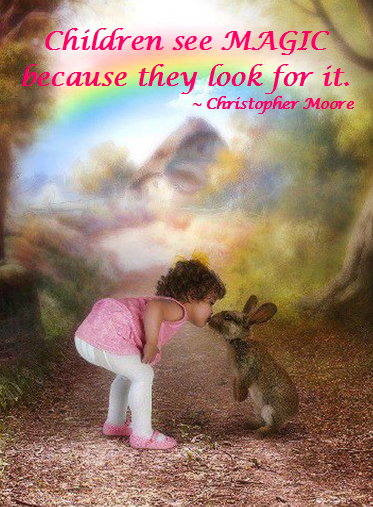
Magical Child

•November 15, 2012 • Leave a Comment

In the Islamic tradition, it is believed that children are very blessed beings. This belief is upheld by the understanding that right before they came to Earth they were just with God. Paraphrasing, “Just like rain is a mercy, children are a mercy because like rain, they were just with God.” Ever held a baby close, and smelled their sweetness? The sweet scent of a newborn is believed to be the sweet scent of Paradise. How beautiful is that sentiment: you are holding a piece of paradise in your arms.

In the Islamic tradition, it is believed that a child does not fully comprehend lying or follow our logic about things. They will ‘blatantly lie’ but in fact sincerely believe that what they are saying is true. It is because they are in that blessed realm still trying to figure out this world.  It is as dangerous for us to force the butterfly out of the cocoon, as it is dangerous for us to try to force a child out of this blessed realm. To punish them for their understanding of reality is an obscenity.

In the Islamic tradition, children are believed to be able to see angels till about the age of seven years. When they giggle or babble or coo it may be them playing with angels. In this realm of the unseen, it is where their imagination grows; where they dream up imaginary friends and wonderful adventures. If we leave them be in that realm unhindered – letting them hold onto this sacred piece of childhood – we can only imagine what beautiful dreams they dream, what wonders their magical place holds.

Image source can be found here and through this website.

This post is inspired by a talk given by Hamza Yusuf Hanson of Zaytuna College entitled “The Magical Child”, during a week-long conference on education in early 2001 at the University of Toronto – OISE, in Canada

Our Preschool Experiment Part 1

•November 15, 2012 • 1 Comment

A few weeks ago, the Jibbers and I involved ourselves in a preschool experiment. I did this as a way to see if I am comfortable with my conviction to homeschool him for as long as possible. He did it because I asked him to and told him that I’d be in the classroom with him. So he was satisfied and I was curious.

Play-based learning

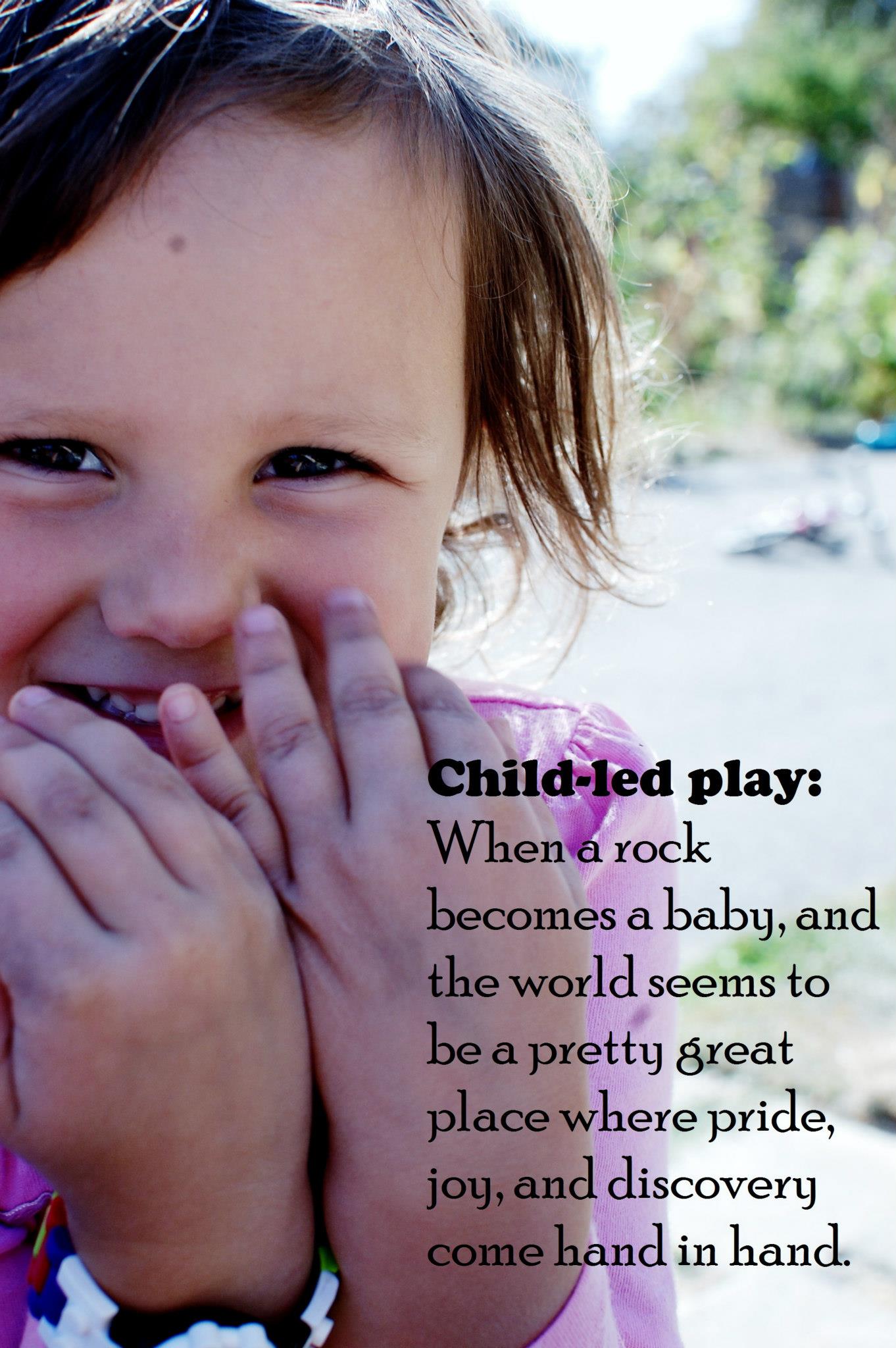
I very strongly hold the belief that between the ages of 0 to 7 children must be primarily exposed to play-based learning. Children learn using their imagination and natural curiosity. Study after study proves this. Yes, our children are sponges, and yes we must provide them with every opportunity to learn. But we must also recognize that children learn best when they are interested in learning the material and when it is child-led.

I’m not opposed to school. I am a product of the public school system. I was lucky though. I went to great public schools and for the most did very well in sports, academics and social life.  I don’t want my son growing up thinking that school is bad, just a different way of learning from the learning done at home.  That said, I am also a firm believer in homeschooling and the benefits of home education.

Preschool misgivings

Back to our preschool experiment. I wanted to see if indeed the Jibbers was missing out on this whole institution called school. I was curious to see how what I saw as a great school espousing many homeschooling philosophies (many ages/grades in one classroom) that I agree with implemented these at the preschool level.

The short of it: they didn’t. While the teacher and school were well-intentioned,  – and this is particularly true for many Muslim schools – it’s scary how these good intentions manifest in a classroom with very limited resources and training. The product of this well-intentioned-few resources process end up being the children.

While the teacher recognized that she lacked many skills in working with young children, and she tried as best she could, it is so easy to forget that they’ve only been on this earth 36-48 months. Believe me, I know, and the Jibbers always reminds me: “Mama, I only three,” and he holds up three pudgy little fingers.

I was concerned by some of the directives throughout the day:

“No noise from you.”

“No skipping.”

“I want to see you all colouring in the lines.”

Besides these observations, students did not sing very much, did not have stories read to them, and had minimal free-play in the schedule. When I asked her, “Oh, is this their free play time?” She responded with, “Yes, I didn’t have time to get the next activity ready.” Oh, I said to myself. I thought the free-play was the activity.

Numbers

On the bright side. While they were taught their numbers 0 to 100, they did not have to know them all and this was done in a song-and-dance style by the teacher. Then they were given a set of 10 cards each that they had to put in order. The Jibbers who can count to 10 took his number cards and put them in a row like he saw the other children doing. I was amused to see him imitating the other children. He, however, did not know what the characters on the card meant – except for the number ‘4’ and my husband and I don’t know why or how he recognizes the number ‘4’. He just does. Working with the children, I realized many of them did not know their numbers or the characters, either.

While the teacher recognized this, I felt the students’ frustration at being exposed to something they may not have been developmentally ready to understand. And this frustration with learning can become a demotivating factor when school becomes more serious, especially for boys. But that’s a post for another day.

Here is an excellent piece on PreSchool Math Lessons and how that affects math ability in later years. Interestingly enough, the two main factors in determining the future success in math was not the quality of preschool a child went to, but the mother with college degree or professional qualifications (0.50) and the highest-quality home learning environment (0.40). And if one may seem lacking, the other can compensate for it.

Preschool models

So, was our preschool experiment a failure? I don’t think so. Not for me or the Jibbers. He got to spend a couple of days playing with a new group of kids with Mama nearby and I was able to see what preschool shouldn’t be. There are a number of preschools that do know what they’re doing and I recommend you visit Teacher Tom and Teach Preschool for ideas and thoughts on preschooling done right.

Respect is timeless.

•November 15, 2012 • Leave a Comment

The Prophet Muhammad said,

“He is not one of us who does not show mercy to young children,

nor honor the elderly.”

(Hadith Tradition: At-Tirmidhi)

Image

Image source can be found here through Free Range Learning.

Curiosity & Learning go hand-in-hand

•November 14, 2012 • 1 Comment

Image can be found at oakmeadow.com

Play-based learning through child-led play

•November 14, 2012 • 1 Comment

Image source can be found here.

Do you remember how to play?

•November 13, 2012 • 2 Comments

It is a happy talent to know how to play.

Ralph Waldo Emerson

A Jibbers in the box, pretending he is a dog in his dog house.

Making sense of the unreal

•November 13, 2012 • Leave a Comment

As astronauts and space travellers children puzzle over the future; as dinosaurs and princesses they unearth the past. As weather reporters and restaurant workers they make sense of reality; as monsters and gremlins they make sense of the unreal.

Gretchen Owocki
Contemporary American early childhood educator

The Jibbers wants to be a princess…

•November 13, 2012 • 1 Comment

My son, the Jibbers, is three-and-a-half and, as is the nature of three-year-olds, he likes to dress up and pretend he is something or someone else.  Every morning when we wake up the family is assigned an animal and the following dialogue ensues:

Jibbers: Today, Mama, we are chinchillas. [That’s my cue.]

Me: Good Morning, Baby Chinchilla, assalaamu alaykum!

Jibbers: Good Morning, Mama Chinchilla! Where is Papa Chinchilla?

Me: Oh, Papa Chinchilla went to work.

And so on. Feel free to insert any animal or critter; I particularly did not like being Mama Cockroach. Still makes my skin crawl! Ew!
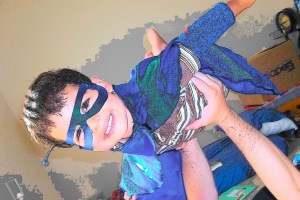
Up, up and away into a world of possibility and imagination blossoming with creativity and fun.

So when the Jibbers comes running to me and says he wants to be a princess – yes, I got him a tiara which I called a crown – or a king, or an astronaut, or a  train driver – not train engineer: “I just want to drive the train; I just a kid.” – or a superhero, or a firefighter or a robot, or any of a number of things he tells me on a daily basis, then I try to facilitate that for him. If being a fireman means he needs a hose, we try to make one. If being an astronaut means he needs “an apparatus” for breathing, we get a small box. I see it as part of his play-based learning and recognize that he needs his imagination and creativity to navigate the realities of this world. All children do.

When children pretend, they’re using their imaginations to move beyond the bounds of reality. A stick can be a magic wand. A sock can be a puppet. A small child can be a superhero.

Fred Rogers

Thank you, Mr Rogers for helping us see what children innately understand.

Play gives children a chance to practice what they are learning.

Fred Rogers

As of late, I have seen this video circulating on facebook:

‘Princess’ is not a career.

I was concerned. I know ‘princess’ is not a career, but why is it important for Sesame Street to let preschoolers know about it so adamantly. Yes, we’d like our children to be successful and have careers with growth potential, but are we missing something important here when we tell children, “No you can’t be a ‘princess’ because that is not a career.” Well, at three years old or four or five, do they really  need to know what a career is?

When this video was posted on a friend’s facebook page, one mother, in particular, got what I was feeling:

“…the Princess stage can be used to ones benefit. That’s a lot more to being a Princess (or super hero…) then the tiaras (masks) and jewels (weapons). It’s a great platform to teach the kids community responsibility, self responsibility & discipline, decorum, and to encourage their imagination. It’s how you as the adult approach the situation.”

I sincerely believe that that is the purpose of play: for children to learn about the real world in a way and at a pace that is suitable for them. And really, how long are children in this blessed realm for? Six, seven, maybe till eight years old? In an age where our children are being forced to ‘grow up’ at such an alarming rate, sometimes it’s nice to keep things simple and let the children play.

THE FLIP SIDE: I asked my husband, and a friend of mine about this video and what their thoughts were. My friend is a former vice principal of a private school and has a four-year-old daughter. Her daughter has not been exposed to any “princess” movies for a very specific reason: “I don’t want my daughter to live in a world of fantasy, where some prince charming is going to save her.” I believe this sentiment is shared by many parents of daughters, especially when we want to empower our daughters. I was also told there may be issues of entitlement at play (no pun intended) and parents don’t want their daughters to be exposed to that culture. I agree with both points, but I don’t think I agree with the approach of negating imaginary play, or an aspect of it, as the way to get the point across. And finally, this from one of the comments in the original video post:

I just showed this to my four year old daughter.
Me: So what career do you want to have?
Her: A judge.
Me: Yay! (high fives)
Her: Well, actually, Mommy, I want to be a princess.
Me: But they just talked about how being a princess isn’t a career.
Her: It’s okay, Mommy. I’ll be a princess and a judge and a pirate.

Hmm….

Where do the children play?

•November 12, 2012 • 1 Comment

Image

I am a big fan of Yusuf, and also a big fan of play. Thank you for highlighting the importance of play especially for our children.

 
Zeyneb Sayılgan

Muslim Reflections On Our Human Journey

MAMANUSHKA

Faith, Motherhood, Culture, Resources, Food & Life

Identity Crisis

Indigenous, Latinx, Muslim, Feminist

Fig & Olive

Increased Stations

Alfie Kohn

The Work Of Alfie Kohn

Meri Cherry

Adventures in Process Art

gadflyonthewallblog

"To sting people and whip them into a fury, all in the service of truth."

Splendid Pearls

Orthodox Sunni Islam

My Patronus Is Coffee

Life is Messy. Send Coffee and Posh.

Baraka Birth

birth doula | fertility support | women's health

the CHILD centered

where parent and teacher CONNECT

Praying With One Eye Open

Thoughts on motherhood, the writer life, and staying awake

TED Blog

The TED Blog shares news about TED Talks and TED Conferences.

dr. p.l. (paul) thomas

educator, public scholar, poet&writer - academic freedom isn't free

An Ethical Island

How to Teach Without a Lecture and other fun

The Finer Points

A Blog About All Things Fine Arts at the University of Utah.